
When travelers visit Labuan Bajo, the first attractions that usually come to mind are Komodo dragons, Padar Island, and beautiful beaches. However, the mainland of Flores offers another fascinating attraction: Manggarai traditional houses.
These traditional homes reflect the history, beliefs, social structure, and craftsmanship of the Manggarai people. Visiting one can provide a deeper understanding of Flores beyond its natural scenery.
For travelers looking for a Labuan Bajo cultural tour, exploring traditional Manggarai architecture is an experience worth adding to the itinerary.
1. What Is a Manggarai Traditional House?
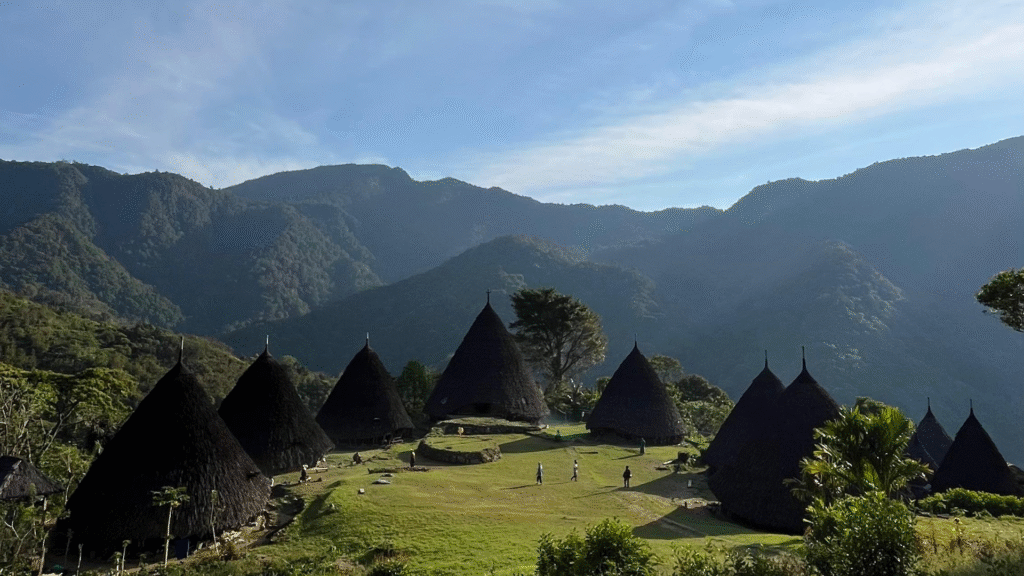
The traditional house of the Manggarai people is commonly known as Mbaru Niang in some communities. Its distinctive cone-shaped structure makes it immediately recognizable.
The most famous examples can be found in traditional villages such as Wae Rebo. The houses have large conical roofs made from natural materials, creating a unique silhouette against the surrounding mountains.
Wae Rebo’s traditional architecture has received international recognition. UNESCO included the village’s traditional house settlement in its Intangible Cultural Heritage-related documentation and cultural programs.
2. The Unique Cone-Shaped Design
The cone-shaped roof is one of the most recognizable features of a Manggarai traditional house.
The structure rises from a circular base and narrows toward the top. Traditional materials such as wood, bamboo, and natural fibers form important parts of the construction.
The design is not simply about appearance. The structure reflects local knowledge of construction and the relationship between architecture and the surrounding environment.
For photographers, the distinctive roof also creates one of the most memorable architectural images in Flores.
3. More Than Just a Home
Traditional houses have important social and cultural functions.
In Manggarai communities, the traditional house can serve as a place for family activities, meetings, ceremonies, and cultural practices. The building therefore represents more than private living space.
The house can also symbolize connections between family members, ancestors, and the wider community.
This cultural meaning makes visiting a traditional village very different from simply looking at an old building.
4. Wae Rebo and Manggarai Architecture
Wae Rebo is perhaps the most famous destination for travelers who want to see traditional Manggarai houses.
The village sits in a mountainous area of Flores and is known for its group of distinctive conical houses. Reaching Wae Rebo requires a trek through forested terrain, which makes the journey part of the experience.
Visitors can learn about traditional architecture while also experiencing the community’s mountain environment.
If you are planning a Flores tour package, Wae Rebo can be combined with other cultural and natural attractions.
5. Traditional Materials and Craftsmanship
Manggarai traditional houses demonstrate the importance of local craftsmanship.
Wood provides the main structural elements, while bamboo and natural fibers can be used for other components. Traditional building techniques have developed through generations of local knowledge.
The construction requires an understanding of structure, materials, climate, and community traditions.
Preserving these techniques is therefore important because they represent both architecture and cultural knowledge.
6. The Cultural Meaning of the Roof
The roof is not merely a practical covering.
Traditional Manggarai architecture often carries symbolic meanings connected with family, ancestors, and spirituality. The upper section of the house can have a special cultural significance within the community.
These meanings may vary between villages and communities. Therefore, travelers should listen to local guides when learning about the symbolism rather than assuming that every traditional house follows exactly the same beliefs.
7. How to Visit Respectfully
Traditional villages are living communities, not museums.
Visitors should dress appropriately, follow local instructions, and ask permission before entering certain areas or photographing residents.
If a traditional ceremony takes place during your visit, observe quietly and follow the guidance of community members.
Hiring a local guide can also make the experience more meaningful because you can learn the stories and cultural significance behind the architecture.
8. Add Traditional Houses to Your Labuan Bajo Trip
You do not have to choose between nature and culture during your Flores holiday.
A Komodo Island tour can introduce you to wildlife and marine landscapes, while a cultural excursion can reveal the traditions of the people living on the mainland.
Depending on your available time, you can combine traditional villages with waterfalls, viewpoints, coffee-producing areas, or other attractions.
A private Labuan Bajo tour can be particularly useful when you want more flexibility to include cultural destinations.
Final Thoughts
Manggarai traditional houses provide a fascinating window into the culture and history of Flores. Their distinctive architecture, natural materials, and cultural functions demonstrate the knowledge preserved by local communities over generations.
For travelers who want to experience more than beaches and island adventures, visiting a traditional village can become one of the most meaningful parts of a Labuan Bajo holiday.
Plan Your Labuan Bajo Holiday
Ready to explore Komodo and Flores? Visit komodopadartour.com to choose Labuan Bajo tour packages, Komodo trips, private tours, and cultural experiences.
If you are interested in buying or renting land, speedboats, rental houses, or shop houses (ruko) in Labuan Bajo, visit komodolabuanbajoproperty.com to explore available property opportunities.
 English
  Arabic
  Chinese
  French
  German
  Italian
  Korean
  Russian
  Spanish
  Indonesian