
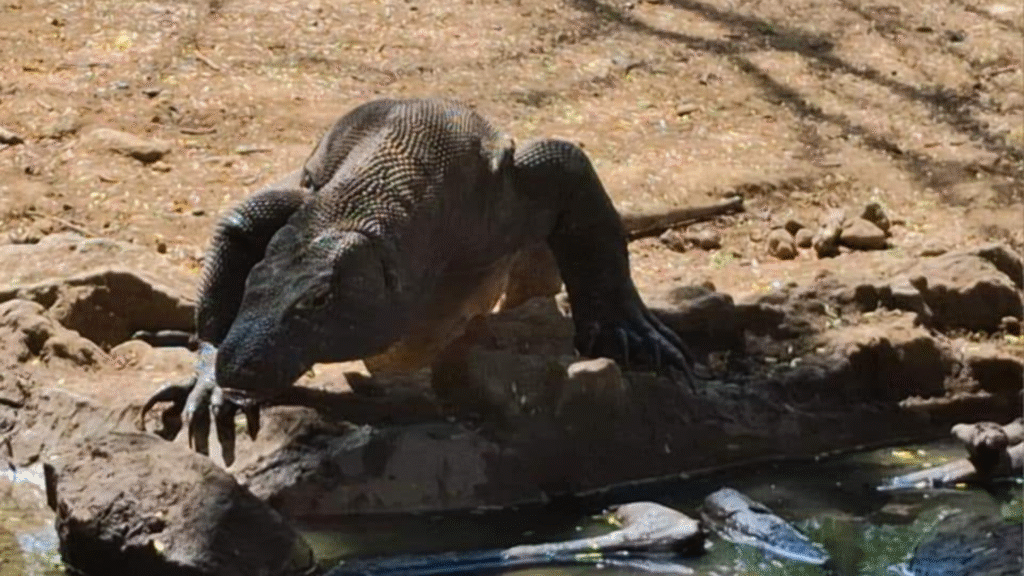
这 Komodo Dragon Social Behavior is one of the most fascinating aspects of the world’s largest living lizard. Although Komodo dragons are often described as solitary predators, they regularly interact with one another in ways that help them survive, reproduce, and compete within their environment.
From territorial displays and courtship rituals to feeding hierarchies and communication through body language, Komodo dragons demonstrate complex behaviors that continue to interest wildlife researchers and nature enthusiasts alike.
Visitors exploring Komodo National Park often have the opportunity to observe some of these natural interactions during guided trekking tours.
1. Are Komodo Dragons Solitary Animals?
For most of their lives, 科莫多巨蜥 live alone.
Adult dragons usually spend their time hunting, resting, or patrolling their territory without forming permanent groups.
However, being solitary does not mean they never interact with each other.
During feeding, breeding, or territorial encounters, Komodo dragons regularly come into contact with other dragons.
These interactions reveal an interesting social structure that is rarely seen by casual observers.
2. Feeding Hierarchy
One of the clearest examples of Komodo dragon social behavior appears when several dragons gather around the same prey.
Instead of feeding randomly, larger and older dragons usually eat first.
Younger dragons patiently wait nearby until the dominant animals finish before approaching the carcass.
This feeding order helps reduce unnecessary conflict while allowing several dragons to benefit from the same food source.
Although aggressive encounters sometimes occur, clear dominance often prevents serious fights.
3. Territorial Behavior
Adult Komodo dragons maintain territories that provide access to food, shelter, and breeding opportunities.
When another dragon enters the area, the resident animal may respond with warning displays or physical confrontation.
Territorial disputes usually involve:
- Standing tall
- Hissing
- Tail movements
- Wrestling
- Pushing with powerful bodies
These displays help determine dominance while avoiding unnecessary injuries whenever possible.
4. Courtship and Mating
During the breeding season, social interactions become much more frequent.
Male Komodo dragons actively search for females and may compete with rival males for mating opportunities.
Before mating, males often perform ritualized behaviors to attract females and establish dominance.
Successful males remain near receptive females until mating occurs.
This seasonal behavior plays an important role in maintaining healthy wild populations.
5. Communication Through Body Language
Komodo dragons rely heavily on body language rather than vocal communication.
Their behavior can communicate confidence, submission, aggression, or curiosity.
Common signals include:
- Head movements
- Body posture
- Tail positioning
- Tongue flicking
- Slow or rapid movement
These visual cues help dragons assess situations before deciding whether to approach, retreat, or defend themselves.
6. Young Dragons Behave Differently
Juvenile Komodo dragons face many challenges.
Because large adults may attack smaller dragons, young individuals spend much of their time climbing trees to avoid predators.
This unique behavior allows them to survive during the most vulnerable stage of their lives.
As they grow larger, they gradually spend more time on the ground and begin competing for territory like adult dragons.
7. Observing Natural Behavior in Komodo National Park
Visitors to 科莫多国家公园 may witness many aspects of Komodo dragon social behavior during guided treks.
Park rangers often explain how dragons interact, defend territory, compete for food, and respond to changing environmental conditions.
Observing these behaviors in the wild provides a much deeper appreciation of one of the world’s most extraordinary reptiles.
Because Komodo dragons are wild predators, visitors should always remain with their ranger and follow all safety instructions throughout the trek.
Discover the Fascinating Social Behavior of Komodo Dragons
The Komodo Dragon Social Behavior demonstrates that these remarkable reptiles are far more complex than many people realize. Although they spend much of their lives alone, they regularly interact through territorial displays, feeding hierarchies, courtship, and body language that help maintain balance within their natural environment.
Watching these interactions in Komodo National Park is one of the highlights of any wildlife adventure in Indonesia.
Planning your adventure? Visit komodopadartour.com to discover customized Komodo tours, private boat charters, wildlife trekking experiences, and unforgettable holidays throughout Komodo National Park and Flores.
Additionally, visit komodolabuanbajoproperty.com to explore premium investment opportunities and real estate in 拉布安巴焦, one of Indonesia’s fastest-growing tourism destinations.




 English
  Arabic
  Chinese
  French
  German
  Italian
  Korean
  Russian
  Spanish
  Indonesian