
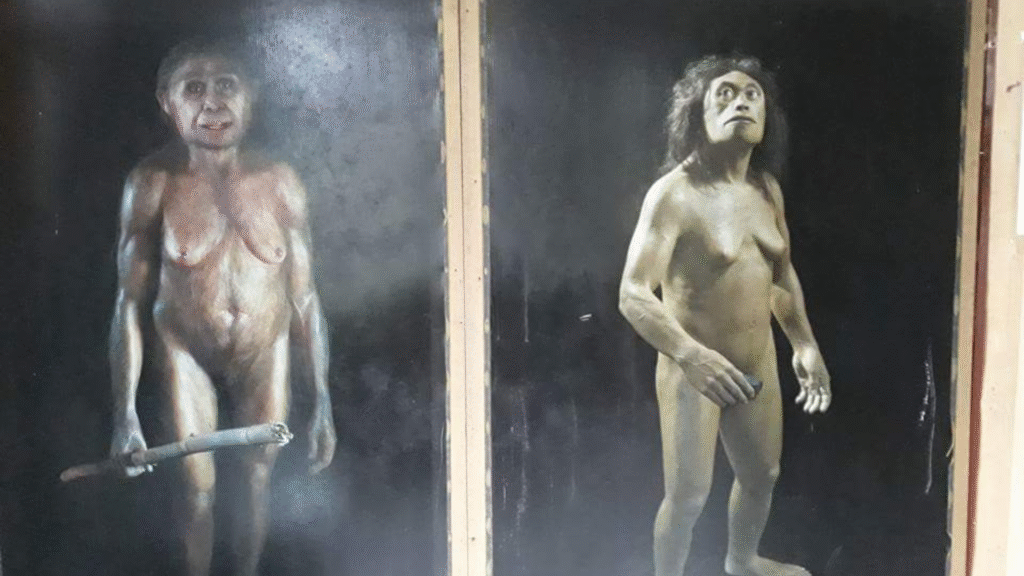
Лян Буа is one of the most extraordinary archaeological sites in the world — a limestone cave on Остров Флорес, Индонезия where the remains of a previously unknown human species were discovered in 2003. Often called the “Hobbit Cave,” this place has captivated scientists and travelers alike because of its connection to Homo floresiensis, a small-bodied hominid that once lived thousands of years ago.
🏞️ Location and Setting
Liang Bua Cave is located in Округ Манггарай, о 14 km north of Ruteng on Flores Island. The area is set within a dramatic landscape of rolling hills, river valleys, and tropical vegetation — a fitting backdrop for one of the most famous prehistoric discoveries in Southeast Asia.
The cave itself is formed from limestone and has a large entrance that gradually narrows — ideal for sediment accumulation that preserved ancient remains over tens of thousands of years.
🧬 Discovery of the “Hobbit”
В September 2003, an Indonesian–Australian research team uncovered a nearly complete skeleton inside Liang Bua. The skeletal remains belonged to a species of hominid later named Homo floresiensis. Its small stature — about 1 meter tall — and other anatomical features led scientists to nickname it the “Flores Hobbit.”
Homo floresiensis lived on Flores Island roughly between 190,000 and 50,000 years ago, according to more recent research, much earlier than originally assumed
This discovery was globally significant because it challenged what scientists understood about early human diversity and migration. The existence of a small-bodied human species that used tools and survived in isolation reshaped archaeological theories about human evolution.
🧪 What You Can See Today
Visitors to Liang Bua can explore:
- Он cave entrance and interior where the fossils were found
- Exposed excavation areas showing layers of ancient sediment and debris
- A small visitor center or museum with replicas, casts, and displays about the discovery, stone tools, and other archaeological finds
- Surrounding landscapes that once supported ancient human life and animals, including extinct fauna like the straight-tusked elephant relative Stegodon.
Guided tours led by local guides help explain the scientific importance of the site and provide context about how fossils were preserved and recovered.
📜 The Scientific Controversy
Although labeled the “Hobbit,” there has been ongoing scientific debate about where Homo floresiensis fits within the human lineage and what caused its extinction. Some researchers once speculated that the remains were from a modern human with a growth condition, but further studies suggest H. floresiensis represents a distinct, now-extinct hominid species.
The cause of their extinction is still not fully understood, though recent studies suggest environmental change and competition for resources may have played a role.
🚶♂️ Visiting Liang Bua Today
Liang Bua is accessible by land from Ruteng, a nearby town with guesthouses and eateries. Many visitors combine a visit to the cave with other cultural and natural attractions in Flores, such as traditional villages, rice terraces, and scenic drives.
The best time to visit is during the сухой сезон (апрель-октябрь) when roads are more reliable and walking around the site is easier. Local guides often enhance the experience by sharing stories about the discovery and its scientific significance.
🧠 Заключение
Лян Буа is much more than a cave — it’s a window into our prehistoric past. The discovery of Homo floresiensis here changed how scientists view early human diversity and evolution. Today, visitors to Liang Bua can connect with one of the most compelling archaeological stories in the world, explore real excavation sites, and reflect on a time when small-statured humans walked this island long before modern civilization
“Испытайте приключение всей жизни — забронируйте тур в Национальный парк Комодо прямо сейчас!» komodopadartour.com!”




 English
  Arabic
  Chinese
  French
  German
  Italian
  Korean
  Russian
  Spanish
  Indonesian