
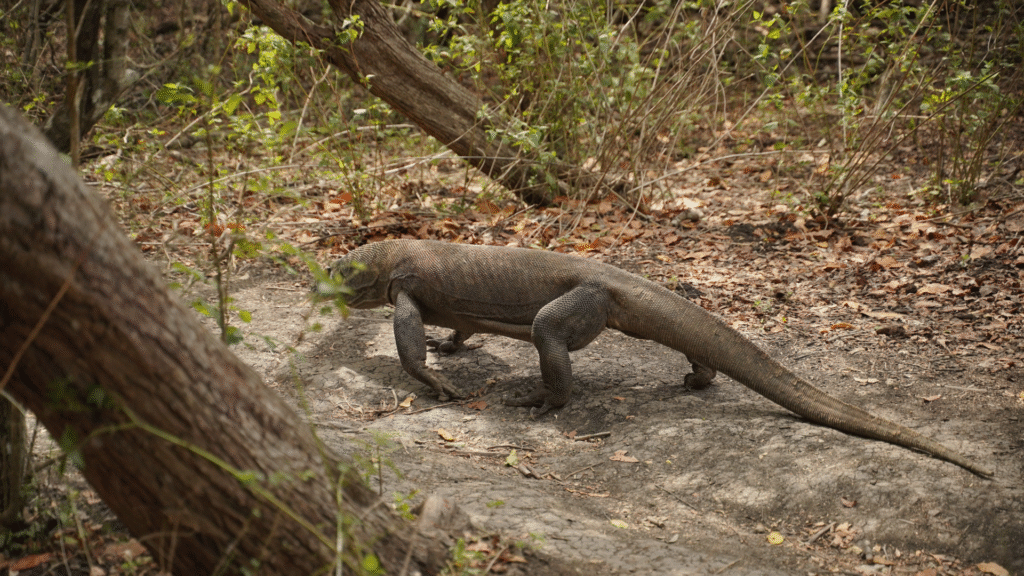
Parc national de Komodo is best known as the home of the Komodo dragon. However, the park protects much more than this famous reptile. Its islands, forests, savannas, mangroves, and surrounding waters support a remarkable variety of wildlife.
For travelers, exploring Komodo National Park offers the chance to see animals both on land and underwater. From wild deer and colorful birds to manta rays and sea turtles, every area can reveal something different.
1. Komodo Dragons
The Komodo dragon is the main attraction for most visitors. These giant lizards live naturally on several islands within the national park.
Adult dragons can reach impressive sizes. They spend much of their time resting, walking through forests, or searching for food. Their behavior can change depending on weather and environmental conditions.
Wildlife encounters are unpredictable. Therefore, visitors should never expect to see a Komodo dragon at a specific location or time.
A ranger accompanies visitors during trekking activities. Following the ranger’s instructions is essential because these are wild predators.
2. Timor Deer
Timor deer are another important animal in the park’s ecosystem. They are among the natural prey of Komodo dragons and can often be found around grasslands and forest edges.
Seeing a deer can also provide an interesting insight into the relationship between different species. The presence of prey animals supports the survival of Komodo dragons and other predators.
Visitors should observe deer quietly from a safe distance. Avoid chasing or disturbing them.
3. Wild Boar and Other Land Animals
Wild boar also form part of the Komodo ecosystem. These animals can move through forests and savanna areas while searching for food.
The islands are also home to other reptiles and small mammals. Although they may not attract as much attention as the Komodo dragon, they play important roles within the local environment.
Because wildlife moves freely, every trekking experience can be different. A quiet trail may suddenly become an exciting wildlife encounter.
4. Birds of Komodo National Park
Birdwatchers can also find interesting species across the national park. Various birds live around forests, savannas, coastal areas, and mangrove habitats.
Depending on the location and season, travelers may spot birds flying above the hills or resting among trees. Some species are easier to identify by their calls than by sight.
Bringing binoculars can make birdwatching more enjoyable. A camera with a suitable zoom lens can also help capture distant wildlife without approaching too closely.
5. Manta Rays and Marine Wildlife
Komodo National Park extends beyond the islands. Its surrounding waters contain rich marine ecosystems that attract divers and snorkelers from around the world.
Manta rays are among the most exciting marine animals to encounter. These graceful creatures can sometimes be seen swimming through nutrient-rich waters around the park.
Sea turtles, reef fish, and other marine species also inhabit the area’s coral reefs. Consequently, a trip that combines trekking and snorkeling can provide a much more complete wildlife experience.
6. Sea Turtles and Coral Reef Life
Sea turtles are another highlight for visitors exploring the waters around Komodo. They can sometimes be seen while snorkeling or diving near coral reefs and coastal areas.
Below the surface, the variety continues. Colorful reef fish, corals, and other marine organisms create an underwater environment that contrasts strongly with the dry landscapes on land.
This combination makes Komodo National Park unusual. Within the same trip, travelers can explore savanna hills in the morning and discover vibrant marine life later in the day.
7. Wildlife Encounters Are Unpredictable
One of the most important things to understand about Komodo wildlife is that sightings cannot be guaranteed.
Animals are not kept in cages or displayed in controlled areas. They live in their natural environment and move according to their own behavior.
Therefore, travelers should focus on enjoying the entire experience rather than searching only for one particular animal. The landscape, forests, beaches, and ocean are all part of the adventure.
8. How to Watch Wildlife Responsibly
Responsible wildlife tourism helps protect the animals and their habitat. Visitors should maintain a safe distance and never attempt to touch or feed wild animals.
During trekking, stay with the ranger and follow the designated path. Do not approach a Komodo dragon for photographs, even if it appears calm.
When snorkeling or diving, avoid touching coral and marine animals. Simple actions like these help preserve the park for future visitors.
9. Experience Komodo’s Wildlife
Komodo National Park offers much more than a chance to see the world’s largest lizard. Its diverse ecosystem supports mammals, reptiles, birds, marine animals, and countless smaller species.
A well-planned trip can combine wildlife trekking, snorkeling, scenic viewpoints, and beach visits in one adventure. Travelers looking for a flexible experience can explore options through komodopadartour.com.
For those interested in staying longer or exploring opportunities in Labuan Bajo, komodolabuanbajoproperty.com also provides information about property opportunities in the region.
Ultimately, the best way to experience Komodo wildlife is to remain patient, respectful, and ready for unexpected encounters.


 English
  Arabic
  Chinese
  French
  German
  Italian
  Korean
  Russian
  Spanish
  Indonesian